Guides · West Midlands prices
How much does an air source heat pump cost in the West Midlands?
Typical prices, grants and sample quotes
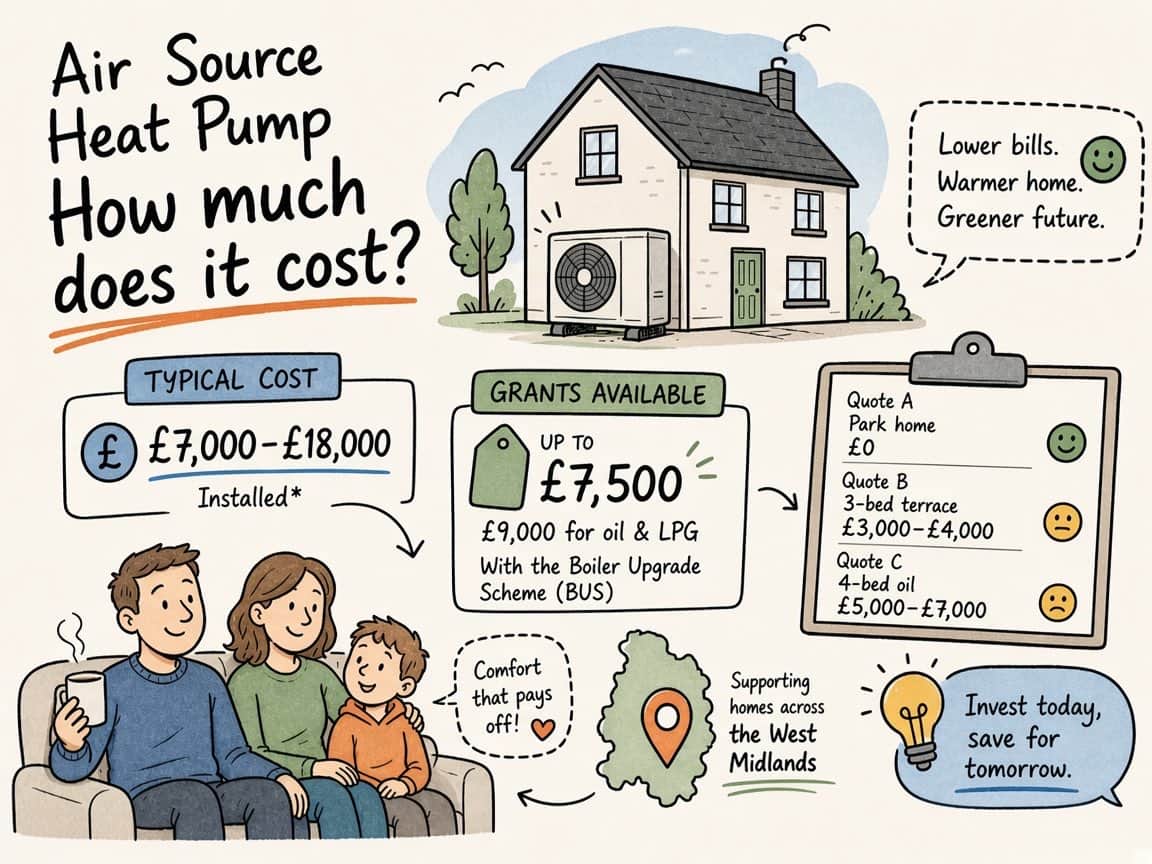
The typical air source heat pump cost in the West Midlands falls between £7,000 and £18,000 before any grant, depending on your property size and what extra works are needed. That range sounds wide, but once you know your property type and heating situation, it narrows quickly. And once the Boiler Upgrade Scheme grant is applied, many homeowners in Birmingham and across the West Midlands end up paying a fraction of that figure, or nothing at all.
The national figures you find online are often vague averages that do not reflect what a real installation actually costs in this region. The sample quotes and cost breakdowns throughout this article are drawn from home surveys carried out by Green Glow Insulation, our MCS certified installation team based in Rowley Regis. We have completed local installations across Birmingham and the wider West Midlands for six years. These are illustrative figures from real properties in this region, not estimates padded for a national audience.
By the end of this article you will know the likely upfront air source heat pump cost for your property type, which grant you qualify for and how it gets applied, and why the figure you pay can still move after survey if the design has to change. No fluff. Just the numbers you need to make a sensible decision.
Air source heat pump cost: what the full installation price covers
The main components you're paying for
When you receive an installed price, it covers several distinct elements. The heat pump unit itself is the largest single cost, typically in the range of £4,000–£8,000 depending on output size, based on current market pricing from MCS certified suppliers. A hot water cylinder commonly adds around £1,000–£1,500; controls and thermostat another £500–£1,000; and refrigerant pipework plus the labour to connect everything accounts for the rest. MCS certification paperwork is also included in a proper installation quote, and that paperwork is what makes you eligible for the Boiler Upgrade Scheme grant.
The biggest driver of unit cost is output, measured in kilowatts. A well-insulated 3-bed terrace in Birmingham will often need an 8kW unit. A 4-bed detached in Solihull may need 12kW or more. The price difference between those two units is significant, which is why you cannot rely on a single national average.
Air source heat pump cost by property type in the West Midlands
Based on current supply and fit prices from MCS certified installers, here is a practical breakdown by property type:
- Flat or small terrace
- £7,000–£8,000
- 2–3 bed semi-detached
- £7,000–£10,000
- 4–5 bed detached
- £12,000–£20,000
Government-backed installation data puts the median cost of an air source heat pump installation at £12,908, with the middle 50% of reported installations costing between £11,128 and £15,627. These figures come from the Boiler Upgrade Scheme statistics, based on installation costs reported through the Microgeneration Certification Scheme (MCS), and cover the cost of the system, labour and VAT. They represent reported costs for BUS supported installations rather than equipment only prices or online estimates. Larger systems and higher cost installations can exceed £18,000, so a broad price range is more useful than relying on a single headline figure.
The extra works that push your bill higher
The customer contribution is not a single fixed number. It sits on the designer's design, the layout that keeps pipe runs, electrics and the cylinder in the most cost effective positions. If you do not agree with that design and want the unit, tank or pipework placed differently, the contribution changes, and it is usually more expensive. The designer's design is the cheaper route because it is built around the house as it stands, not around a preferred cupboard or a preferred wall.
A survey quote can also move once work starts. Pipe sizes, existing wiring and where the outdoor unit has to sit are not always visible until we open up. The two jobs below are real installs where the contribution rose after that kind of hiccup.
Radiator and pipework upgrades
A gas boiler pushes water around your radiators at 70–80°C. A heat pump works at 45–55°C. That lower flow temperature means your existing radiators may not produce enough heat output to warm each room adequately, because radiator output drops significantly at lower temperatures. A properly sized radiator for a heat pump system often needs to deliver roughly 2–2.5 times the output of what was adequate for a boiler, a rule of thumb consistent with UK heat pump installation guidance.
Swapping a single radiator typically costs £150–£350 fitted. A full house radiator upgrade across 8–10 units commonly adds £2,500–£5,500 to your total ASHP installation cost. The critical point here is that you cannot know how many radiators actually need changing without a room-by-room heat loss calculation. Many homes need fewer changes than they expect, particularly if existing radiators are already oversized or if rooms have since had insulation added.
Pipework is a separate issue from swapping emitters. The pipe from a heat pump to each radiator needs to be in the 15–28mm range. If the existing run is narrower than that, it has to be replaced — even when the radiators themselves can stay. On a Birmingham job the radiators were already in, but every heat-pump-to-radiator pipe was undersized. We changed the lot to bring it into that 15–28mm range. The customer paid around £1,500 extra on top of the grant. That is the kind of unknown hiccup that can move the contribution after the first quote. the survey prices what we can see, opening up the pipework can still add a line.
Insulation and electrical works
Homes with poor insulation lose heat faster than a heat pump can replace it efficiently. If your loft or cavity walls need attention, budget £1,000–£5,000 depending on what is required. Homeowners who have already had insulation installed through ECO4 or an earlier scheme are in a strong position, the fabric is already sorted, and the heat pump can be sized accordingly without additional spend.
On the electrical side, a heat pump needs a dedicated supply circuit. In older properties, an upgraded consumer unit or an additional circuit can add a few hundred pounds, commonly in the region of £300–£600, though costs vary depending on the existing installation. Most homes built after 2000 are less likely to need a full consumer unit upgrade, but it is worth confirming during a home survey so nothing appears as a surprise on installation day.
Siting the outdoor unit and the indoor cylinder is the other cost driver. On one job the heat pump and the hot-water tank could both have gone in the positions the designer specified, the tank where it fitted the pipe runs, the unit outside on a short cable. The customer wanted the new tank in the same cupboard as the old one. That meant the outdoor heat pump sat further from the cylinder, so the electrical run and interconnecting cablework had to be longer. The extra wirework went onto the bill. Adjusting a design to match a preference, rather than the designer's cost-effective layout, is how a contribution that looked settled at survey picks up an overhead.
Old boiler, cylinder and oil tank removal
Many reputable MCS installers include removal and disposal of your existing gas boiler, old hot water cylinder, and any oil or LPG tank as part of the installation quote, but practices do vary, and some online prices strip out removal costs and add them back as extras. Always ask for an itemised quote and confirm what is covered. At Green Glow Insulation, old boiler and tank removal is included in our fixed quote, so the number you see is the number you pay.
How the Boiler Upgrade Scheme grant cuts the real air source heat pump cost
The standard £7,500 grant for gas-boiler replacements
The Boiler Upgrade Scheme (BUS) pays £7,500 directly off the installer's invoice for air to water heat pump installations that replace a fossil fuel heating system in England and Wales. The grant is claimed by the MCS certified installer on your behalf. You do not complete a form or wait for a rebate cheque, you simply pay the net figure after the grant has been deducted.
For a mid terrace 3-bed in Birmingham with a total installed price of around £10,000–£12,000, this reduces your outlay to £2,500–£4,500. That is the real cost to you, not the headline installation price.
The £9,000 grant for oil and LPG properties
From 21 July 2026 to 31 March 2027, eligible offgas-grid properties on oil or LPG can access a temporarily increased grant of £9,000. This applies to air to water heat pump installations in properties currently heated with oil or LPG, and it changes the maths considerably. For park homes and rural properties where the total installed cost falls below £9,000, the grant can cover the entire bill with nothing left for the homeowner to pay.
Eligibility, who claims it, and the oil/LPG uplift: Boiler Upgrade Scheme explained.
Who qualifies and what the conditions are
To qualify for the Boiler Upgrade Scheme, the property must be in England or Wales and the applicant must own the property. If you rent, your landlord would need to apply — we can still survey and design the system with their permission. The existing heating system must be fossil-fuel-based, and the installer must be both MCS certified and registered with Ofgem as a BUS participant. Social housing and new builds are excluded, with a narrow exception for self builds. Properties that have already received government or Energy Company Obligation funding for the same installation are not eligible.
Green Glow Insulation is registered with Ofgem as a BUS participant and handles the grant claim as part of the installation process. In practice, this means homeowners do not need to navigate Ofgem's portal or manage paperwork themselves, your installer submits the claim on your behalf before you pay the net amount. For confirmation of any installer's BUS registration status, you can check the Ofgem BUS participant register directly.
See if the grant applies to your home
The 30-second checker is the quickest way to know. We claim BUS as part of the install — you never fill in the Ofgem form.
Annual running costs: heat pump vs gas boiler
What you will spend heating your home each year
Using 2026 UK electricity tariffs (approximately 26p per kWh on a standard variable rate, in line with the current Ofgem price cap), annual heat pump running costs fall roughly as follows:
- Small homes
- £612–£699 / year
- Medium homes
- £895–£1,119 / year
- Large homes
- £1,469–£2,121 / year
The variable that drives these figures is the system's seasonal coefficient of performance, or SCOP. A well sized and properly commissioned system achieves a SCOP of 3.0–3.5, meaning three or more units of heat are produced for every unit of electricity consumed. Running costs can be reduced further by switching to a dedicated heat pump electricity tariff. Several UK energy suppliers now offer cheaper overnight rates specifically for heat pump users, which can cut annual bills meaningfully if your system is configured to run during off-peak hours. It is worth asking your installer to set the controls accordingly during commissioning.
How this compares to a gas boiler
A heat pump does not bring your heating bills down. Compared with a gas boiler, running cost is not the reason to switch: you should not expect the annual figure to fall, and we do not sell the job on a saving. The point of the change is to replace fossil-fuel heating with a low-carbon system, which is how UK homes cut the warming effect of gas, oil and LPG burned on the premises. You also step off gas and oil price spikes. Electricity still has a unit rate, but you are no longer tied to wholesale gas moves in the same way, and there is no separate gas water-heating cost — the heat pump covers space heating and hot water.
A gas boiler in a medium home currently costs in the region of £1,100–£1,205 a year to run. A heat pump in the same home sits in a similar band on a standard electricity tariff. Treat those as comparable running costs, not as a payback case. The grant is what makes the capital cost work. The climate case, and protection from fossil-fuel price shocks, is why people go ahead when the bills look similar.
Real West Midlands prices: what the survey numbers look like
Mid-terrace in Birmingham replacing a gas boiler
A 3-bed mid-terrace in Birmingham on mains gas, with loft insulation already in place from an ECO4 scheme, is one of the most common scenarios in our local survey data. A heat-loss assessment typically identifies an 8kW unit as sufficient, with around 3 of 8 radiators needing upgrading. Total installed price before grant: approximately £10,500–£11,500. After the £7,500 BUS grant, the homeowner pays £3,000–£4,000. Running costs sit in a similar band to the old gas boiler, the switch is not a bill-cut, it replaces fossil fuel and takes the home off gas price shocks. These are illustrative figures based on local installation examples. The contribution can still move if pipework or siting is not what the first quote assumed, as in the Birmingham pipe size job above.
- Installed (before grant)
- £10,500–£11,500
- BUS grant
- − £7,500
- Homeowner pays
- £3,000–£4,000
Detached home on oil heating
A 4-bed detached in Solihull or on the Wolverhampton outskirts, currently on oil, with some adequate radiators and a cylinder replacement needed, typically comes in at £14,000–£16,000 installed. After the £9,000 BUS grant available to oil properties under the July 2026 uplift, the homeowner pays £5,000–£7,000. Oil prices move harder than electricity, which is why the long term case is about stepping off a volatile fuel, not about a lower annual bill. Treat running costs as comparable, not as a payback clock.
- Installed (before grant)
- £14,000–£16,000
- Oil/LPG BUS grant
- − £9,000
- Homeowner pays
- £5,000–£7,000
Park home on LPG
A park home in the West Midlands on LPG has a smaller heat demand and a lower total installed price, commonly £7,500–£9,000. With the £9,000 BUS grant for off-gas-grid properties, the homeowner can pay nothing or close to nothing. LPG is a fossil fuel with a volatile unit price, the heat pump takes the home off that fuel. Do not read that as a guaranteed cut in what you spend each year, the purpose is the same as on gas: replace the fossil system, and reduce how much fuel price swings dictate the bill. For LPG park homes, the net air source heat pump cost after the £9,000 grant is typically zero or close to it, the strongest capital case in the BUS programme. A free home survey will confirm grant eligibility and produce a fixed quote before any commitment is made.
- Installed (before grant)
- £7,500–£9,000
- Oil/LPG BUS grant
- − £9,000
- Homeowner pays
- £0 or close to it
What to do next
The key figures to take away, the total installed air source heat pump cost before grants typically runs from £7,000 to £18,000 depending on your property, with larger or more complex installs at the higher end, the BUS grant of £7,500 or £9,000 is deducted before you pay anything. Running costs are not why you switch, a heat pump does not cut the annual heating bill versus gas, and we do not quote it that way. You replace fossil fuel, you cut the warming from burning gas, oil or LPG in the home, and you are less exposed to those fuel prices. The biggest unknown in any individual case is still the heat loss survey, and whether the designer's layout is the one you go with, because that determines unit size, pipework, where the cylinder sits, and whether the contribution stays at the first quote or rises when something hidden (undersized pipes, a longer electrical run) has to be put right.
Green Glow Insulation offers free home surveys across Birmingham and the West Midlands. We carry out the MCS heat-loss assessment, confirm your BUS grant eligibility, and provide a fixed quote with the grant already deducted. Get in touch with our team to book your survey and you will have a fixed quote with the grant deducted, and a clear picture of what still depends on the designer's layout being the one you accept.
Book a free home survey
We’ll size the system, confirm your grant, and give you a fixed quote with the grant already deducted. No obligation.
Prefer to write to us? Request a survey on the contact page.